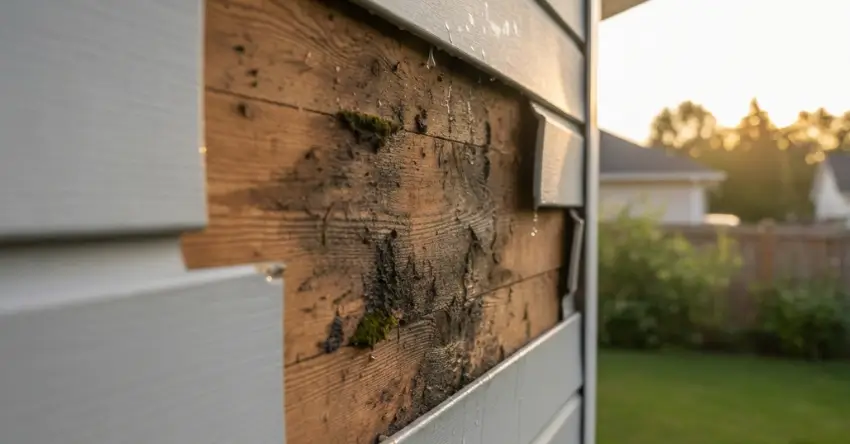
For most of us, our Connecticut home isn’t just a property; it’s where we create memories, seek refuge after a tiring day, and where our family feels safe. However, our state’s climate can be a tough neighbor. Between January snowstorms and July’s dense humidity, your home’s exterior works overtime every day.
Often, we focus on the beauty of the siding, the fresh color, the flawless texture. But here’s a truth that’s rarely said: even the most luxurious material on the market is just a veneer. If what’s behind that veneer is neglected, your home is in danger.
At GOAT Siding, we understand that water damage is a “silent enemy.” It doesn’t warn you when it’s coming; it works in the dark, rotting the structure long before you notice any signs inside your home. Our commitment is not just to aesthetics, but to the real integrity of your home.
Why Haste Can Be Costly?
Many homeowners, upon noticing a problem, seek the quickest solution. The market is full of companies that promise to “install over” or simply replace the surface panels. But, for us, that’s like putting a bandage on a wound that needs stitches.
The GOAT Standard is born from empathy. We ask ourselves: “If this were my house, would I accept just hiding the problem?”. The answer is always no. That’s why we decided to educate our clients so they know exactly what to look for.
The Signs Your House Sends (and how to listen to them)
Water infiltration rarely starts with a bang. It starts with small whispers. Learning to read these signs can be the difference between preventative maintenance and a complete structural rebuild.
1. Wavy Siding
When walking through your yard, observe the reflection of light on your siding. If it feels slightly uneven, as if there are waves under the surface, stop and pay attention.
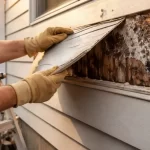
- The Touch Test: Gently press the panels with your hand. The siding should feel like a firm structure. If you feel the material give way or has a “spongy” texture, it’s a sign that the structural wood (the sheathing) is saturated. It has lost its ability to support the weight of the boards because it is being consumed by moisture.
2. When the Interior Reveals the Exterior
It’s ironic, but we often discover siding problems in the living room. If you notice bubbles in the paint, wallpaper peeling off at the corners, or small yellowish stains near the windows, the diagnosis is almost certain: water has already penetrated the outer barrier and reached your drywall.
We know how frustrating it is to invest in interior decoration and see the finish spoil. The problem is that when moisture reaches the interior, your home’s thermal insulation has already lost its efficiency, and mold may be starting to grow where no one sees it.
3. Stains
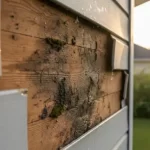
Pay attention to joints, corners, and especially window frames. If there are dark stains or a buildup of mold that reappears even after cleaning, water is trapped.
The Warning: These stains usually indicate that water has entered through a fault in the caulking or flashing and is now “washing” rotten wood out through the cracks.
Why “New Siding” Doesn’t Always Solve the Problem?
Replacing siding without investigating what’s underneath is like changing a tire on a car with a broken axle. At GOAT Siding, our approach is technical, but our motivation is personal. We don’t want you to spend your money on a temporary solution.
Every Connecticut town presents a challenge. The salty air of Fairfield demands materials that don’t corrode; the harsh cold of Litchfield requires barriers that can withstand extreme expansion and contraction. Our methodology involves:
- Deconstruction: We remove the old material to see the real situation. We inspect every inch of the plywood (OSB/Plywood) for structural fatigue.
- The Role of Modern Barriers: We use state-of-the-art thermal barriers (Weather Resistant Barriers). They function like human skin: they allow vapor from inside the house to escape (to prevent internal mold), but prevent rainwater from entering.
- Precision in Details: Most leaks occur at intersections. Therefore, we install metal flashing at each critical point where the roof meets the wall, above windows, and on deck steps.
The Cost of Waiting for the Next Cycle
In Connecticut, time is a crucial factor. A small leak detected in October can become a structural disaster in April. Why? Because of the freeze cycle. The water that enters the cracks freezes and expands, forcing the nails out and tearing the fibers.
Softened wood siding.
We don’t want you to feel pressured by a salesperson, but rather guided by an expert. Our mission is to ensure you have all the information to make the best decision for your property.
Your home deserves the GOAT Standard
Don’t wait for a stain on the ceiling or a persistent musty smell to investigate the health of your home. The value of your home and, more importantly, the well-being of your family depends on an external barrier that truly works.
At GOAT Siding, we are passionate about transforming homes and protecting stories. If you suspect your siding isn’t doing its job, or if you simply want the peace of mind of knowing your home is protected and intact, we’re here to help.
Do you feel your home is truly protected for the coming season? Don’t put off protecting your biggest investment. Let’s talk and conduct an honest technical assessment, focused on what’s best for you and your zip code.
Schedule a GOAT Standard Moisture Inspection today and sleep soundly